Anatomy of a task package#
A task package is the folder KernelFoundry evaluates. It defines one optimization task: the kernel to be rewritten, something to compare it against, and the tests that decide whether a candidate is correct and fast.
On the recommended path you do not write one. A coding agent builds it from the kernel you point it at, and this page is what it builds; see Optimize a kernel with a coding agent. Read on if you are authoring a package by hand, or checking what an agent produced.
If you are writing one yourself, start from
tasks/example_custom/
in the repository and adapt it. That is faster and less error-prone than starting from scratch.
File structure#
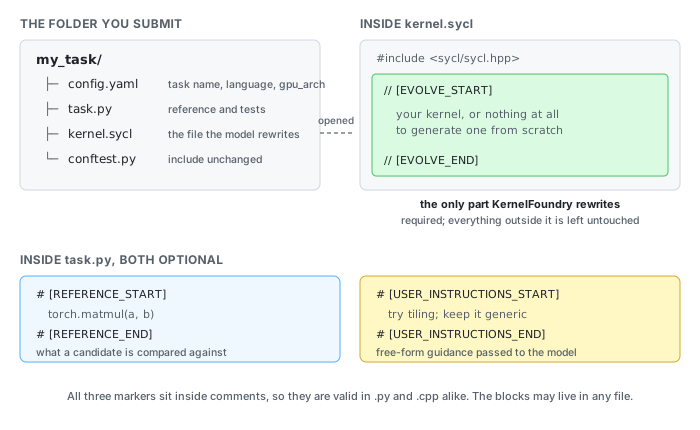
A package broadly consists of:
File |
Purpose |
|---|---|
|
Task name, language, target GPU architecture, iteration settings. See Config parameters. |
|
Defines the task: a reference implementation (often a PyTorch operation) and the tests a kernel must pass. See Writing tests. |
|
The kernel file the model rewrites. It can be almost empty at the start, as long as it carries the evolve markers below. |
|
A baseline implementation to compare against, when the reference is not expressed in |
|
Must be included unchanged. Its only job is to wire your task into the KernelFoundry pytest fixtures. |
Block structure#
Three markers tell KernelFoundry which parts of your code mean what. Because they sit inside
.py or .cpp files, they are always written inside comments.
[EVOLVE_START]/[EVOLVE_END]The only region KernelFoundry will rewrite. Everything outside it is left untouched. This block is required. It may be empty; leave it empty to generate a kernel from scratch with no given function header, includes or bindings.
[REFERENCE_START]/[REFERENCE_END]The implementation the kernel is compared against, for example
torch.matmul(a, b), where the task is to write a custom kernel that beats it. Usually also used to check correctness, by comparing output tensors. Optional: you can instead guide the model purely through user instructions and test the kernel some other way.[USER_INSTRUCTIONS_START]/[USER_INSTRUCTIONS_END]Free-form guidance passed to the model: optimization strategies worth trying, what will be tested, constraints to respect. Optional, but the cheapest way to steer a run. See Optimization strategies.
Notes:
By default all three blocks are included in the prompt, so the model sees the reference, the code to evolve, and your instructions together.
The blocks can live anywhere; KernelFoundry searches every file you provide. In practice it is clearest to keep a dedicated kernel file holding the evolve block.
Steps for creating a task#
Define the evolve block in your kernel file.
Define a reference. Usually required, since it is what correctness and speedup are measured against.
Optional: add user instructions.
Edit
config.yaml: at minimumtask_name,job_name,languageandgpu_arch. See Config parameters.Write tests: at least one correctness test and exactly one benchmark. See Writing tests.
Then validate locally before spending compute on a full run:
pytest --ref -s task.py
That runs your tests against the reference rather than the kernel. If the reference does not pass its own tests, the task definition is wrong and no amount of kernel generation will fix it. See Quickstart for a complete worked example.